Deep Groove Ball Bearings: The Complete Industrial Guide to Types, Applications & Selection
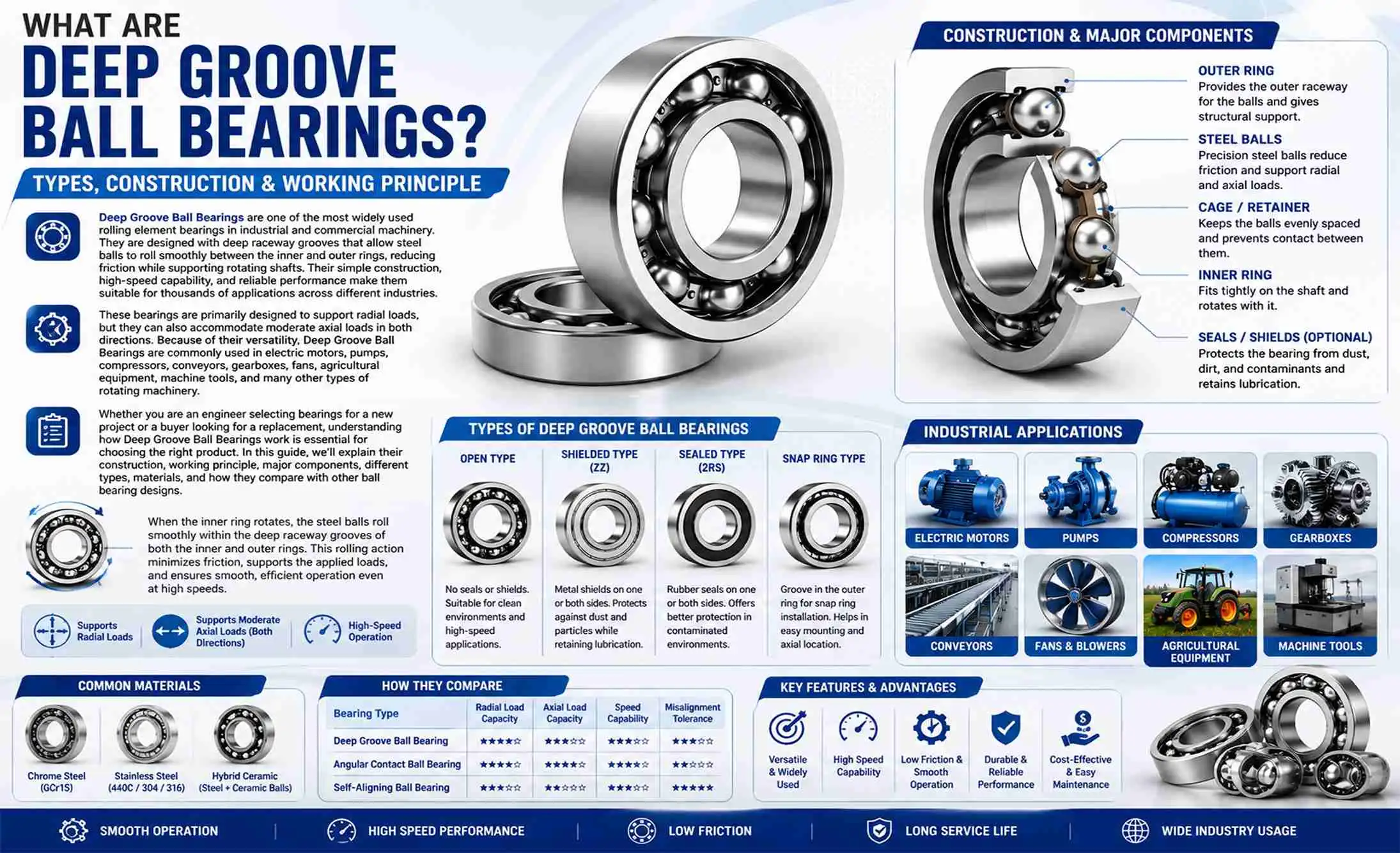
Deep Groove Ball Bearings are one of the most commonly used rolling bearings in industrial machinery because they offer reliable performance, low friction, and high operating speeds. Their simple design makes them suitable for a wide range of applications, from electric motors and pumps to conveyors, gearboxes, compressors, and agricultural equipment.
These bearings are primarily designed to support radial loads, but they can also accommodate moderate axial loads in both directions. Available in open, shielded, and sealed designs, they provide flexibility for different operating environments, maintenance requirements, and contamination levels.
Today, Deep Groove Ball Bearings are manufactured in standardized series such as 6000, 6200, and 6300, allowing engineers and buyers to select bearings based on shaft size, load capacity, speed, and application. Their standardized dimensions also make replacement and maintenance easier across various industries.
Whether you are selecting bearings for a new machine or replacing worn components, understanding their design, applications, and selection criteria is essential for improving equipment reliability and reducing downtime. This guide provides a complete overview of Deep Groove Ball Bearings while linking to more detailed resources on individual topics, helping you make informed purchasing and engineering decisions.
What Are Deep Groove Ball Bearings and How Do They Work?
Deep Groove Ball Bearings are rolling element bearings designed to reduce friction between rotating and stationary machine components. They use precision steel balls that roll inside deep raceway grooves, allowing machinery to operate smoothly, efficiently, and at high speeds.
These bearings are widely used because they can support radial loads and moderate axial loads while requiring minimal maintenance. Their simple design, standardized dimensions, and versatility make them suitable for everything from small electric motors to heavy industrial machinery.
To understand their internal design, working mechanism, and how they differ from other ball bearings, you can explore our detailed guide on What Are Deep Groove Ball Bearings? Types, Construction & Working Principle, where each component and design feature is explained in greater detail.
Basic Construction and Internal Components
A Deep Groove Ball Bearing consists of an inner ring, outer ring, rolling balls, cage (retainer), and precision-ground raceways. Depending on the operating environment, manufacturers also offer bearings with metal shields or rubber seals to protect against dust, moisture, and lubricant loss.
Each component works together to reduce friction, distribute loads evenly, and ensure smooth rotation. High-quality materials, precision machining, and proper heat treatment play a significant role in determining bearing accuracy, durability, and service life.
If you're comparing open, shielded, and sealed bearings for a specific application, our guide on Open vs Shielded vs Sealed Deep Groove Ball Bearings explains the advantages, limitations, and ideal use cases of each design.
Working Principle and Load Handling
Deep Groove Ball Bearings operate on the principle of rolling contact. As the shaft rotates, the balls roll between the inner and outer raceways, reducing friction and allowing equipment to run efficiently with minimal heat generation.
They are primarily designed to carry radial loads, but the deep raceway geometry also enables them to support moderate axial loads in both directions. This combination makes them one of the most versatile bearing types used in industrial machinery.
Selecting the right bearing depends on operating speed, load, shaft size, and working conditions. Our How to Select the Right Deep Groove Ball Bearing guide explains these factors in detail and helps engineers choose the most suitable bearing for different applications.
Why Deep Groove Ball Bearings Are Widely Used
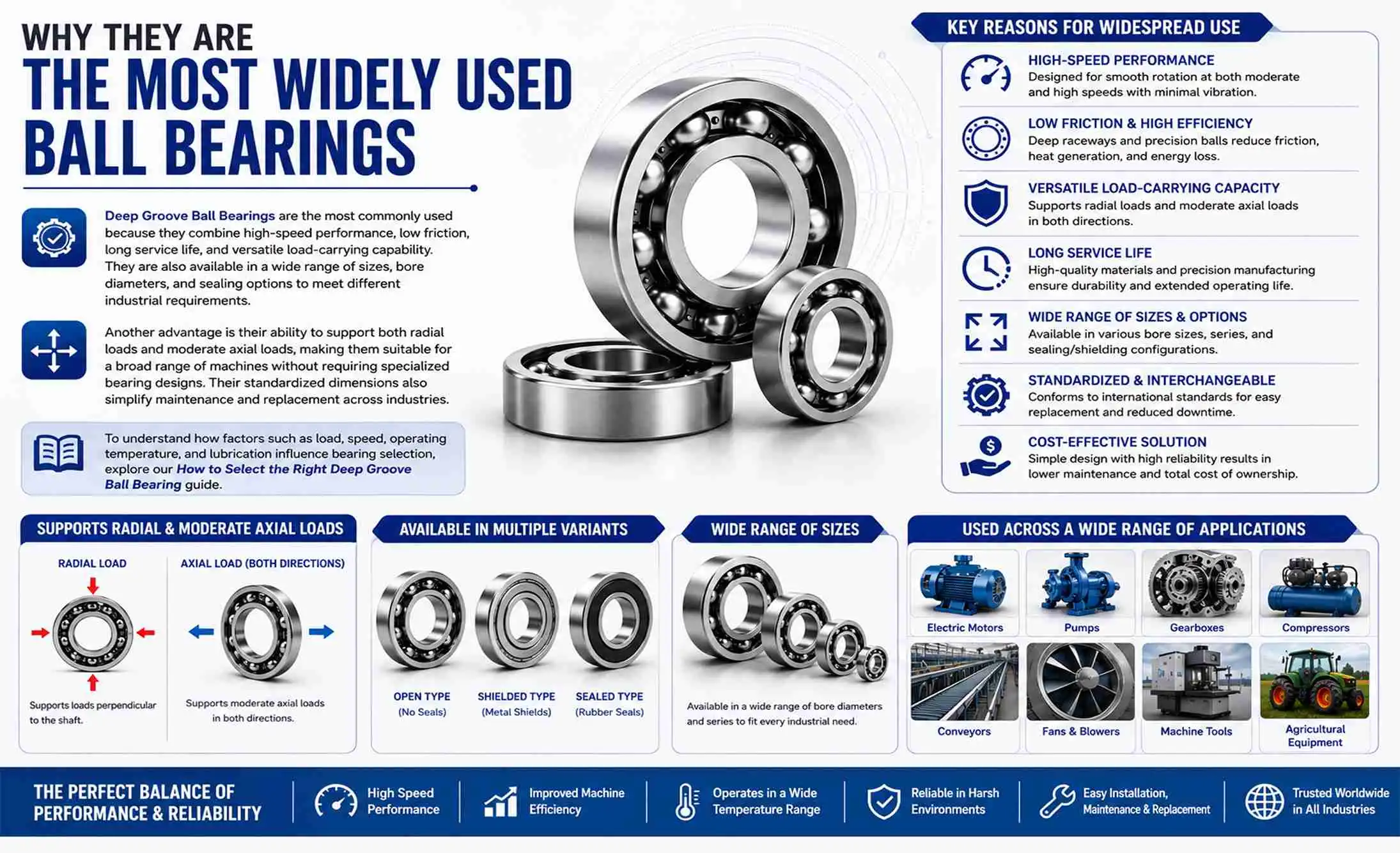
Deep Groove Ball Bearings are used across industries because they offer high-speed performance, low friction, quiet operation, and long service life. Their standardized sizes and wide availability also make maintenance and replacement easier for OEMs and maintenance teams.
They are commonly used in electric motors, pumps, gearboxes, conveyors, compressors, fans, agricultural equipment, and textile machinery, where reliable rotational performance is essential. Different bearing series are designed to meet varying load capacities and dimensional requirements.
If you're unsure which bearing series best suits your application, compare the 6000, 6200, and 6300 Series Deep Groove Ball Bearings to understand their differences in dimensions, load capacity, and typical industrial uses. You can also explore our Deep Groove Ball Bearings Applications Across Different Industries guide to see how these bearings are selected for specific machines and operating environments.
Types of Deep Groove Ball Bearings and Their Industrial Applications
Deep Groove Ball Bearings are available in different designs to meet varying operating conditions, load requirements, and maintenance preferences. While they all share the same basic operating principle, each type is designed to perform better in specific industrial environments.
Choosing the right bearing depends on factors such as contamination levels, operating speed, available space, lubrication requirements, and the type of machine. Understanding these variations helps engineers and procurement teams select bearings that deliver better performance and longer service life.
Single Row Deep Groove Ball Bearings
Single Row Deep Groove Ball Bearings are the most widely used type due to their simple construction, high-speed capability, and ability to accommodate radial and moderate axial loads. They are suitable for both industrial and general engineering applications where smooth and reliable operation is required.
These bearings are commonly used in electric motors, pumps, fans, gearboxes, conveyors, compressors, machine tools, and agricultural machinery. Their versatility and standardized dimensions make them a preferred choice for OEMs and maintenance professionals across various industries.
If you're looking for technical specifications, available sizes, and industrial applications, explore our Single Row Deep Groove Ball Bearings product page. You can also compare different bearing series, including the 6000, 6200, and 6300 Series, to identify the best option for your equipment.
Open, Shielded and Sealed Deep Groove Ball Bearings
Deep Groove Ball Bearings are manufactured in open, shielded, and sealed configurations to suit different operating environments. The choice largely depends on exposure to contaminants, lubrication requirements, and maintenance practices.
Open bearings are suitable where external lubrication is regularly applied and contamination is minimal. Shielded bearings use metal shields to reduce dust ingress while maintaining low friction, whereas sealed bearings use rubber seals to retain grease and provide better protection against moisture, dirt, and other contaminants.
Each design offers distinct advantages depending on the application. For a detailed comparison of their construction, performance, maintenance requirements, and ideal use cases, read our Open vs Shielded vs Sealed Deep Groove Ball Bearings guide.
Popular Bearing Series – 6000, 6200 & 6300
The 6000, 6200, and 6300 Series are among the most commonly used Deep Groove Ball Bearing series worldwide. Although they share the same operating principle, each series is designed with different bore sizes, outside diameters, widths, and load capacities to meet specific application requirements.
The 6000 Series is generally used in compact equipment where space is limited. The 6200 Series offers a balance between size and load capacity, making it suitable for a wide range of industrial machines. The 6300 Series is designed for heavier radial loads and is commonly used in larger electric motors, industrial pumps, and heavy-duty machinery.
To understand the dimensional differences, applications, and selection criteria for each series, explore our dedicated pages for 6000 Series Deep Groove Ball Bearings, 6200 Series Deep Groove Ball Bearings, and 6300 Series Deep Groove Ball Bearings. You can also read our comparison guide, 6000 vs 6200 vs 6300 Series Bearings, to determine which series best fits your operating requirements.
Choosing the Right Deep Groove Ball Bearing for Your Application
Selecting the right Deep Groove Ball Bearing is essential for achieving reliable machine performance and maximizing bearing service life. A bearing that matches the operating conditions can reduce maintenance costs, minimize unexpected downtime, and improve overall equipment efficiency.
Engineers typically evaluate factors such as load, speed, operating temperature, shaft dimensions, lubrication, and environmental conditions before selecting a bearing. Understanding these parameters helps ensure the bearing performs efficiently throughout its expected service life.
Understanding Load, Speed and Operating Conditions
Every bearing application has unique operating requirements. Before selecting a Deep Groove Ball Bearing, it is important to evaluate the radial load, axial load, rotational speed, operating temperature, and environmental conditions in which the bearing will operate.
Applications such as electric motors and fans often require high-speed bearings, while industrial pumps, conveyors, and gearboxes may demand higher load-carrying capacity and greater durability. Selecting the wrong bearing can lead to excessive vibration, premature wear, and unexpected equipment failure.
If you're unsure how these factors influence bearing selection, our How to Select the Right Deep Groove Ball Bearing guide explains the complete selection process with practical examples for different industrial applications.
Bearing Clearance, Lubrication and Material Selection
Bearing performance is influenced by more than just size and load capacity. Internal clearance, lubrication, bearing material, and sealing arrangement all play a vital role in determining operating efficiency and service life.
For example, applications operating at higher temperatures or speeds may require a different internal clearance than standard conditions. Similarly, choosing the appropriate grease or oil helps reduce friction, dissipate heat, and protect the bearing from premature wear.
To learn how these factors affect bearing performance, explore our detailed guides on Deep Groove Ball Bearing Clearance (C2, CN, C3, C4 & C5) and Deep Groove Ball Bearing Lubrication Guide, where we explain how to choose the right configuration for your operating conditions.
Selecting Bearings for Different Industrial Machines
Although the same bearing type may be used across multiple industries, the operating conditions can vary significantly between machines. Equipment such as electric motors, centrifugal pumps, conveyors, compressors, agricultural machinery, and textile machines each place different demands on bearing performance.
Choosing the correct bearing requires understanding the machine's operating speed, load direction, environmental conditions, and maintenance schedule. Selecting a bearing specifically suited to the application improves reliability and helps reduce costly breakdowns.
If you're selecting bearings for a particular industry or machine, our Deep Groove Ball Bearings Applications Across Different Industries guide explains where these bearings are commonly used and how to choose the most suitable solution. You can also explore our Single Row Deep Groove Ball Bearings product page to view available bearing options for industrial applications.
Installation, Lubrication and Maintenance Best Practices
Proper installation and regular maintenance are just as important as selecting the right bearing. Even a high-quality Deep Groove Ball Bearing can experience premature failure if it is installed incorrectly, contaminated during assembly, or operated with insufficient lubrication.
Following recommended installation procedures and maintenance practices helps extend bearing service life, improve machine reliability, and reduce unexpected downtime. A preventive maintenance approach also lowers replacement costs and improves the overall efficiency of industrial equipment.
Proper Bearing Installation
Correct installation begins with using clean tools, handling the bearing carefully, and ensuring that the shaft and housing meet the required dimensional tolerances. Applying installation force to the wrong bearing ring or using improper mounting methods can damage the raceways and rolling elements before the machine even starts operating.
It is equally important to check shaft alignment, seating surfaces, and bearing fits during installation. These factors directly influence operating accuracy, vibration levels, and bearing lifespan.
For a detailed step-by-step process, including mounting methods and common installation mistakes, read our How to Install Deep Groove Ball Bearings Properly guide.
Lubrication for Long Service Life
Lubrication creates a protective film between the rolling elements and raceways, reducing friction, minimizing wear, and helping dissipate heat generated during operation. Selecting the correct lubricant and maintaining the appropriate lubrication interval are essential for reliable bearing performance.
The choice between grease and oil lubrication depends on operating speed, temperature, load, and the surrounding environment. Contaminated or degraded lubricant is one of the leading causes of premature bearing failure in industrial machinery.
Learn how to choose the right lubricant, determine relubrication intervals, and avoid common lubrication mistakes in our Deep Groove Ball Bearing Lubrication Guide.
Preventing Common Bearing Failures
Many bearing failures can be prevented through proper installation, adequate lubrication, routine inspections, and selecting the correct bearing for the application. Common causes of failure include contamination, inadequate lubrication, misalignment, excessive loading, corrosion, and improper handling.
Recognizing early warning signs such as unusual noise, increased vibration, overheating, or lubricant leakage allows maintenance teams to address issues before they result in unexpected equipment downtime.
Our Common Causes of Deep Groove Ball Bearing Failure guide explains the most frequent failure modes, their root causes, and practical maintenance strategies to improve bearing reliability and extend service life.
Installation, Lubrication and Maintenance Best Practices
Proper installation and regular maintenance are just as important as selecting the right bearing. Even a high-quality Deep Groove Ball Bearing can experience premature failure if it is installed incorrectly, contaminated during assembly, or operated with insufficient lubrication.
Following recommended installation procedures and maintenance practices helps extend bearing service life, improve machine reliability, and reduce unexpected downtime. A preventive maintenance approach also lowers replacement costs and improves the overall efficiency of industrial equipment.
Proper Bearing Installation
Correct installation begins with using clean tools, handling the bearing carefully, and ensuring that the shaft and housing meet the required dimensional tolerances. Applying installation force to the wrong bearing ring or using improper mounting methods can damage the raceways and rolling elements before the machine even starts operating.
It is equally important to check shaft alignment, seating surfaces, and bearing fits during installation. These factors directly influence operating accuracy, vibration levels, and bearing lifespan.
For a detailed step-by-step process, including mounting methods and common installation mistakes, read our How to Install Deep Groove Ball Bearings Properly guide.
Lubrication for Long Service Life
Lubrication creates a protective film between the rolling elements and raceways, reducing friction, minimizing wear, and helping dissipate heat generated during operation. Selecting the correct lubricant and maintaining the appropriate lubrication interval are essential for reliable bearing performance.
The choice between grease and oil lubrication depends on operating speed, temperature, load, and the surrounding environment. Contaminated or degraded lubricant is one of the leading causes of premature bearing failure in industrial machinery.
Learn how to choose the right lubricant, determine relubrication intervals, and avoid common lubrication mistakes in our Deep Groove Ball Bearing Lubrication Guide.
Preventing Common Bearing Failures
Many bearing failures can be prevented through proper installation, adequate lubrication, routine inspections, and selecting the correct bearing for the application. Common causes of failure include contamination, inadequate lubrication, misalignment, excessive loading, corrosion, and improper handling.
Recognizing early warning signs such as unusual noise, increased vibration, overheating, or lubricant leakage allows maintenance teams to address issues before they result in unexpected equipment downtime.
Our Common Causes of Deep Groove Ball Bearing Failure guide explains the most frequent failure modes, their root causes, and practical maintenance strategies to improve bearing reliability and extend service life.
Deep Groove Ball Bearing Dimensions, Standards and Buying Guide
Deep Groove Ball Bearings are manufactured according to internationally recognized standards, making them interchangeable across many industrial applications. Standardized dimensions and performance ratings help engineers, OEMs, and maintenance teams select compatible bearings while simplifying replacement and inventory management.
However, choosing the right bearing involves more than matching the bore size. Buyers should also evaluate load ratings, operating speed, internal clearance, sealing arrangement, lubrication requirements, and application-specific conditions to ensure long-term performance.
Standard Bearing Dimensions and Series
Deep Groove Ball Bearings are available in several standardized dimension series, with the 6000, 6200, and 6300 Series being the most commonly used across industrial equipment. Each series offers different combinations of bore diameter, outside diameter, width, and load capacity to suit specific machine requirements.
Selecting the correct bearing series depends on the available installation space and the operating load of the equipment. Understanding these dimensional differences helps ensure proper fitment and reliable operation.
To explore detailed bearing dimensions and available sizes, refer to our Deep Groove Ball Bearing Size Chart. You can also browse the 6000 Series, 6200 Series, and 6300 Series Deep Groove Ball Bearings to compare their specifications and applications.
How to Compare Bearing Specifications
When comparing Deep Groove Ball Bearings, it is important to look beyond the bearing number. Specifications such as dynamic load rating, static load rating, limiting speed, internal clearance, accuracy class, and sealing type all influence how the bearing performs under different operating conditions.
Reviewing these technical specifications allows engineers and buyers to select a bearing that meets the performance demands of the application rather than simply replacing an existing part with the same dimensions.
If you're selecting a bearing for a new project, our How to Select the Right Deep Groove Ball Bearing guide explains how each specification affects bearing performance and helps simplify the selection process.
Choosing a Reliable Industrial Bearing Supplier
A reliable bearing supplier offers more than product availability. They provide consistent product quality, accurate technical guidance, standardized bearing specifications, and dependable support for industrial applications. These factors help reduce procurement risks and improve equipment reliability.
Before placing an order, buyers should verify product specifications, quality standards, application suitability, and delivery capabilities. Working with an experienced supplier also ensures access to the right bearing series for both standard and specialized industrial requirements.
If you're looking for high-quality Single Row Deep Groove Ball Bearings or 6000, 6200, and 6300 Series Bearings, explore our product range or contact our technical team for assistance in selecting the most suitable bearing for your application.
Conclusion
Deep Groove Ball Bearings remain one of the most dependable and versatile bearing solutions used across modern industries. Their ability to operate at high speeds while supporting radial and moderate axial loads makes them suitable for applications ranging from electric motors and pumps to conveyors, compressors, and industrial machinery.
Choosing the right bearing involves understanding its construction, bearing series, operating conditions, lubrication requirements, and maintenance practices. Making informed decisions not only improves equipment performance but also helps reduce maintenance costs and extend bearing service life.
Throughout this guide, we've introduced the key concepts that influence Deep Groove Ball Bearing performance. For a deeper understanding, explore our detailed resources covering bearing selection, installation, lubrication, failure analysis, size charts, and industry applications. These guides provide practical information to help engineers, maintenance professionals, and procurement teams make confident bearing selection decisions.
When you're ready to source reliable industrial bearings, browse our Single Row Deep Groove Ball Bearings, 6000 Series, 6200 Series, and 6300 Series product pages, or contact our team for expert assistance in selecting the right bearing for your application.