Deep Groove Ball Bearings Applications Across Different Industries
Deep Groove Ball Bearings are used in almost every industry because they provide a reliable, efficient, and cost-effective solution for supporting rotating shafts. Their ability to operate at high speeds while handling radial and moderate axial loads makes them suitable for a wide variety of machines, from compact electric motors to heavy industrial equipment.
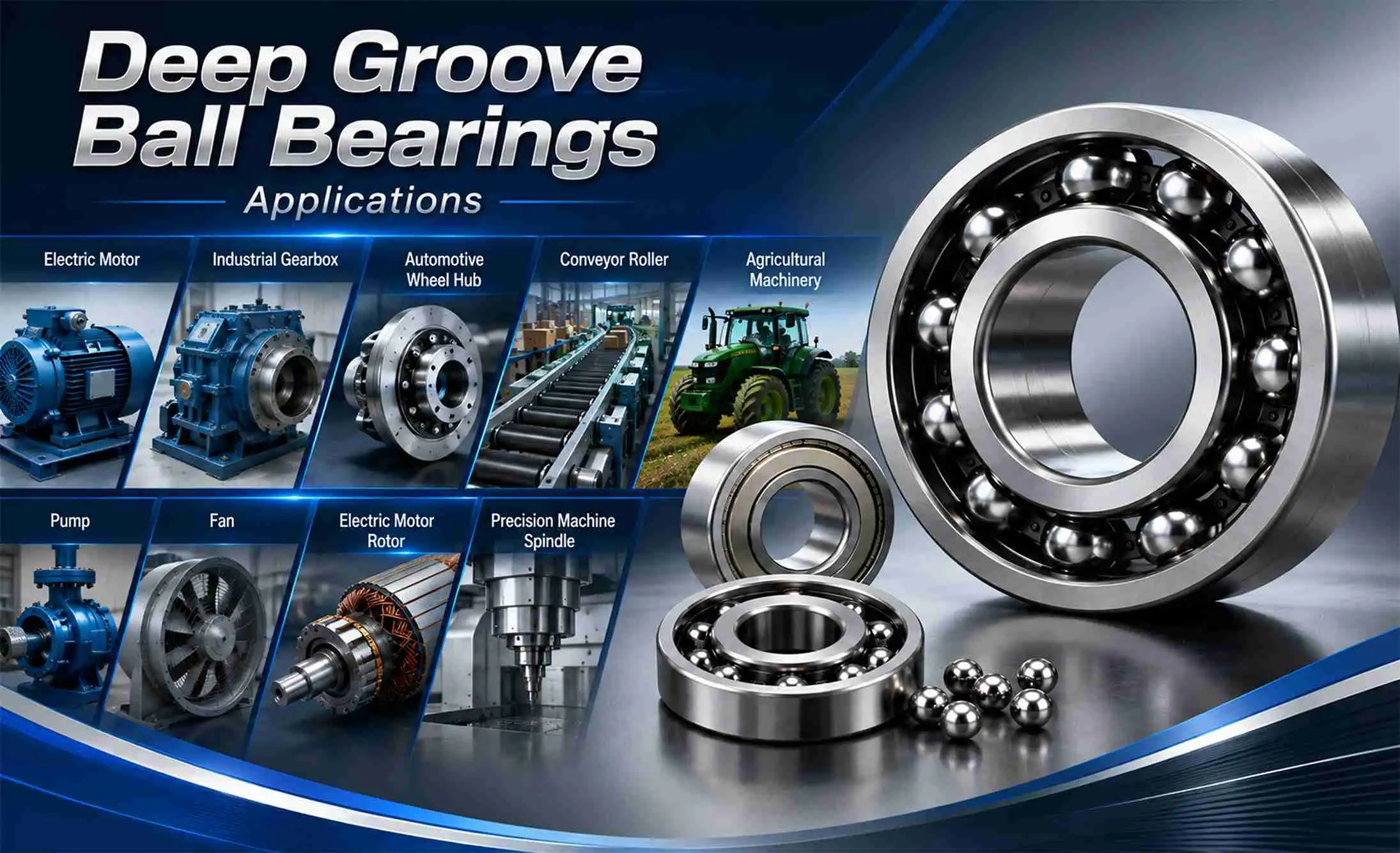
These bearings are commonly found in electric motors, pumps, compressors, conveyors, fans, gearboxes, agricultural machinery, textile equipment, packaging machines, and general manufacturing systems. Their standardized dimensions and wide availability also make maintenance and replacement easier for OEMs and industrial maintenance teams.
However, selecting the right bearing involves more than choosing the correct size. The operating load, rotational speed, environmental conditions, lubrication method, and machine design all influence bearing performance and service life. In this guide, we'll explore how Deep Groove Ball Bearings are used across different machines and industries, along with the key factors to consider when selecting them for your application.
Why Deep Groove Ball Bearings Are Used in So Many Industries
Deep Groove Ball Bearings have become one of the most widely used bearing types because they offer an excellent balance of performance, durability, and versatility. Their simple construction, low friction, and ability to operate under a wide range of conditions make them suitable for both light-duty and heavy-duty industrial applications.
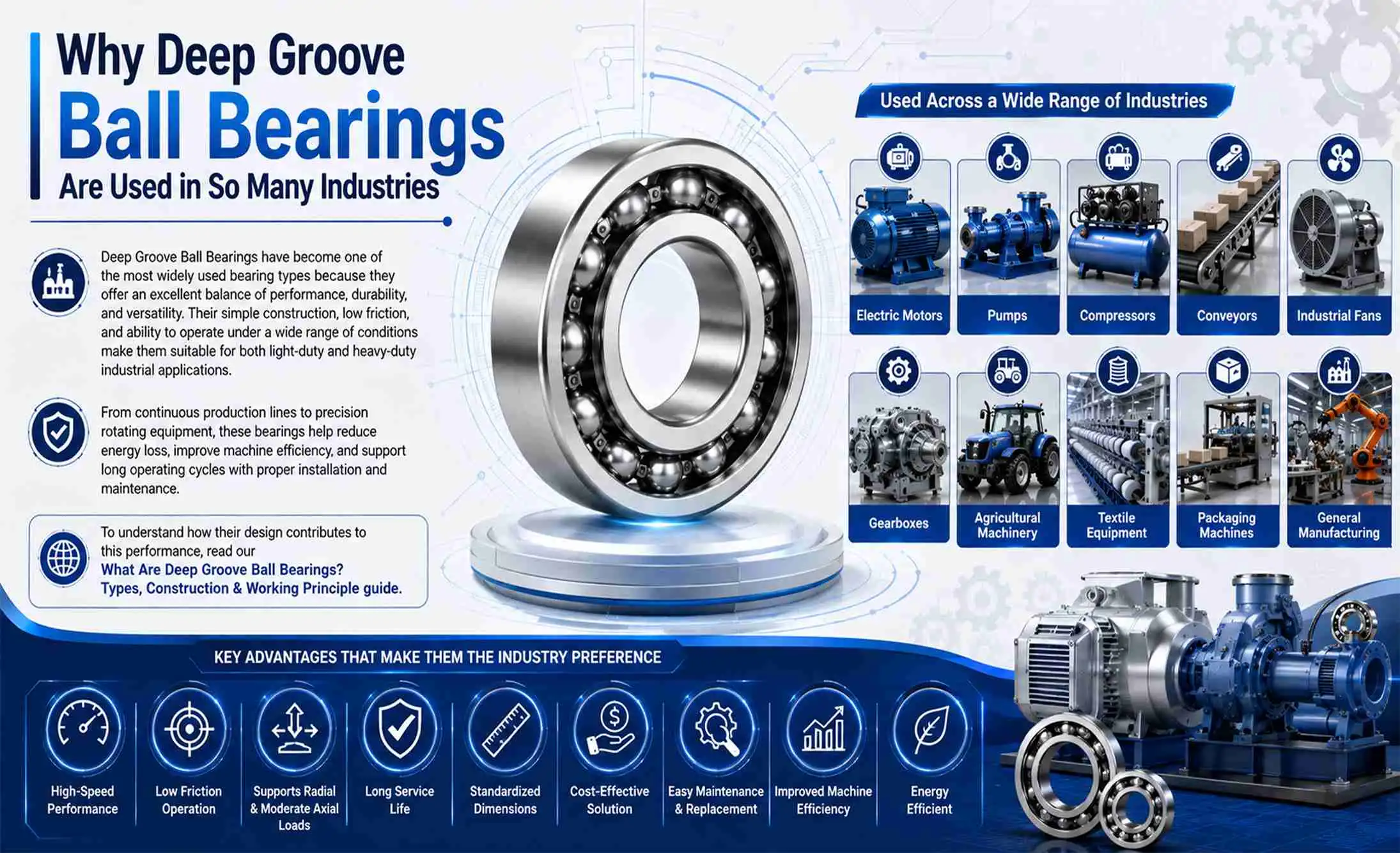
From continuous production lines to precision rotating equipment, these bearings help reduce energy loss, improve machine efficiency, and support long operating cycles with proper installation and maintenance. To understand how their design contributes to this performance, read our What Are Deep Groove Ball Bearings? Types, Construction & Working Principle guide.
Features That Make Them Suitable for Industrial Applications
One of the biggest advantages of Deep Groove Ball Bearings is their ability to deliver smooth, high-speed operation with minimal friction. Their optimized raceway design allows rolling elements to move efficiently, reducing heat generation and improving overall machine performance.
They are also available in a wide range of sizes, sealing options, and standardized series, making them suitable for everything from compact industrial equipment to larger machinery. This flexibility allows manufacturers to use the same bearing family across multiple applications while simplifying maintenance and spare parts management.
For a complete overview of bearing types, construction, and selection, explore our Deep Groove Ball Bearings: The Complete Industrial Guide to Types, Applications & Selection.
Types of Loads They Handle
Deep Groove Ball Bearings are primarily designed to support radial loads, making them ideal for machines where the main forces act perpendicular to the rotating shaft. Their deep raceway grooves also enable them to accommodate moderate axial loads from both directions, increasing their versatility.
This combination makes them suitable for equipment operating under continuous rotation, moderate loading conditions, and high speeds. However, the bearing should always be selected according to the machine's operating requirements to achieve optimum performance and service life.
If you're unsure how load, speed, and operating conditions affect bearing selection, our How to Select the Right Deep Groove Ball Bearing guide will help you understand the key factors involved.
Factors to Consider Before Choosing a Bearing
Although Deep Groove Ball Bearings are highly versatile, selecting the correct bearing requires evaluating several application-specific factors. Operating speed, load direction, shaft size, lubrication method, contamination levels, and ambient temperature all influence bearing performance and reliability.
Choosing the right bearing for the application not only improves machine efficiency but also reduces maintenance costs and unexpected downtime. Understanding these operating conditions before purchasing helps ensure the bearing performs reliably throughout its service life.
Once you've identified your application requirements, the next step is to understand which industrial machines commonly use Deep Groove Ball Bearings and why they are the preferred choice for those applications.
Applications in Industrial Machinery
Deep Groove Ball Bearings are used in a wide variety of industrial machines because they provide smooth rotation, low friction, and dependable performance under continuous operating conditions. Their standardized sizes and ability to operate at high speeds make them a preferred choice for both OEM manufacturers and maintenance teams.
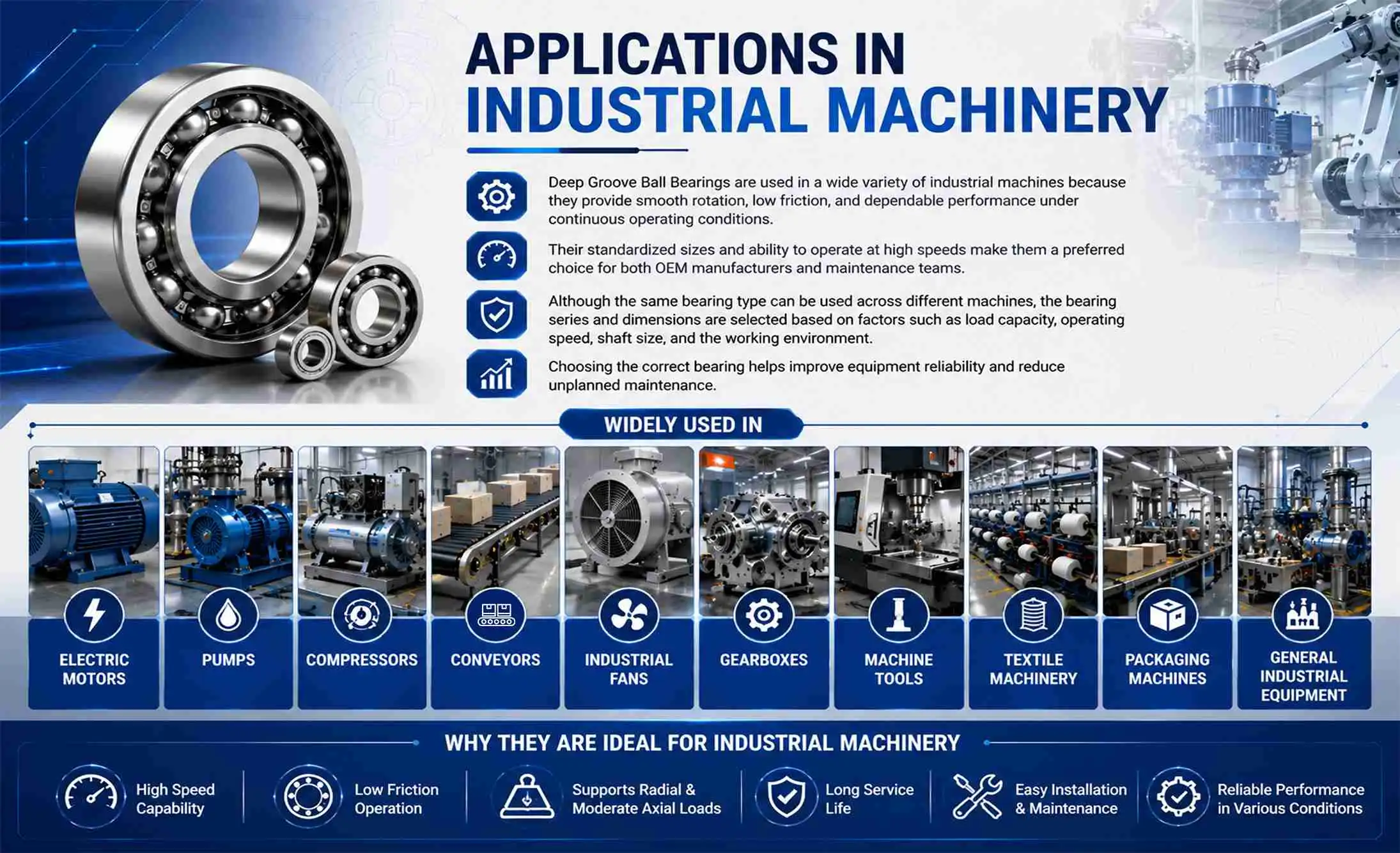
Although the same bearing type can be used across different machines, the bearing series and dimensions are selected based on factors such as load capacity, operating speed, shaft size, and the working environment. Choosing the correct bearing helps improve equipment reliability and reduce unplanned maintenance.
Electric Motors, Pumps and Compressors
Electric motors, industrial pumps, and compressors are among the most common applications for Deep Groove Ball Bearings. These machines require bearings that can operate continuously at high rotational speeds while maintaining low friction and stable performance.
Deep Groove Ball Bearings help support rotating shafts, reduce energy loss, and contribute to smooth machine operation. Their compact design and high-speed capability make them suitable for everything from small electric motors to large industrial pumping systems.
For bearings used in these applications, explore our Single Row Deep Groove Ball Bearings range. You can also compare the 6200 Series and 6300 Series Deep Groove Ball Bearings, which are widely used in electric motors and industrial pumps.
Gearboxes, Conveyors and Material Handling Equipment
Gearboxes, conveyors, and material handling systems operate under continuous loads and require bearings that deliver consistent performance over long operating hours. Deep Groove Ball Bearings are commonly used in these machines because they combine durability with efficient rotational performance.
In conveyor systems and gear-driven equipment, properly selected bearings help reduce friction, improve transmission efficiency, and support reliable operation under varying production conditions. Selecting the appropriate bearing series depends on shaft dimensions, operating loads, and machine design.
If you're selecting bearings for different operating conditions, our Deep Groove Ball Bearings: The Complete Industrial Guide to Types, Applications & Selection explains how bearing series are chosen based on industrial requirements.
Fans, Blowers and HVAC Equipment
Industrial fans, blowers, and HVAC systems typically operate at high rotational speeds for extended periods. These applications require bearings that offer low operating noise, reduced vibration, and dependable performance with minimal maintenance.
Deep Groove Ball Bearings are well suited for these systems because of their precision design and ability to maintain smooth rotation under continuous service. Their availability in sealed and shielded configurations also helps protect against dust and contaminants commonly found in ventilation and air-handling environments.
Choosing the right bearing size and lubrication method is equally important for maximizing service life. If you're learning how bearing design affects performance, read our What Are Deep Groove Ball Bearings? Types, Construction & Working Principle guide to better understand the features that make these bearings suitable for high-speed industrial equipment.
Applications Across Different Industries
Deep Groove Ball Bearings are used in nearly every industrial sector because they offer dependable performance under a wide range of operating conditions. Whether the priority is high-speed rotation, continuous operation, or reliable load handling, these bearings help keep production equipment running efficiently.
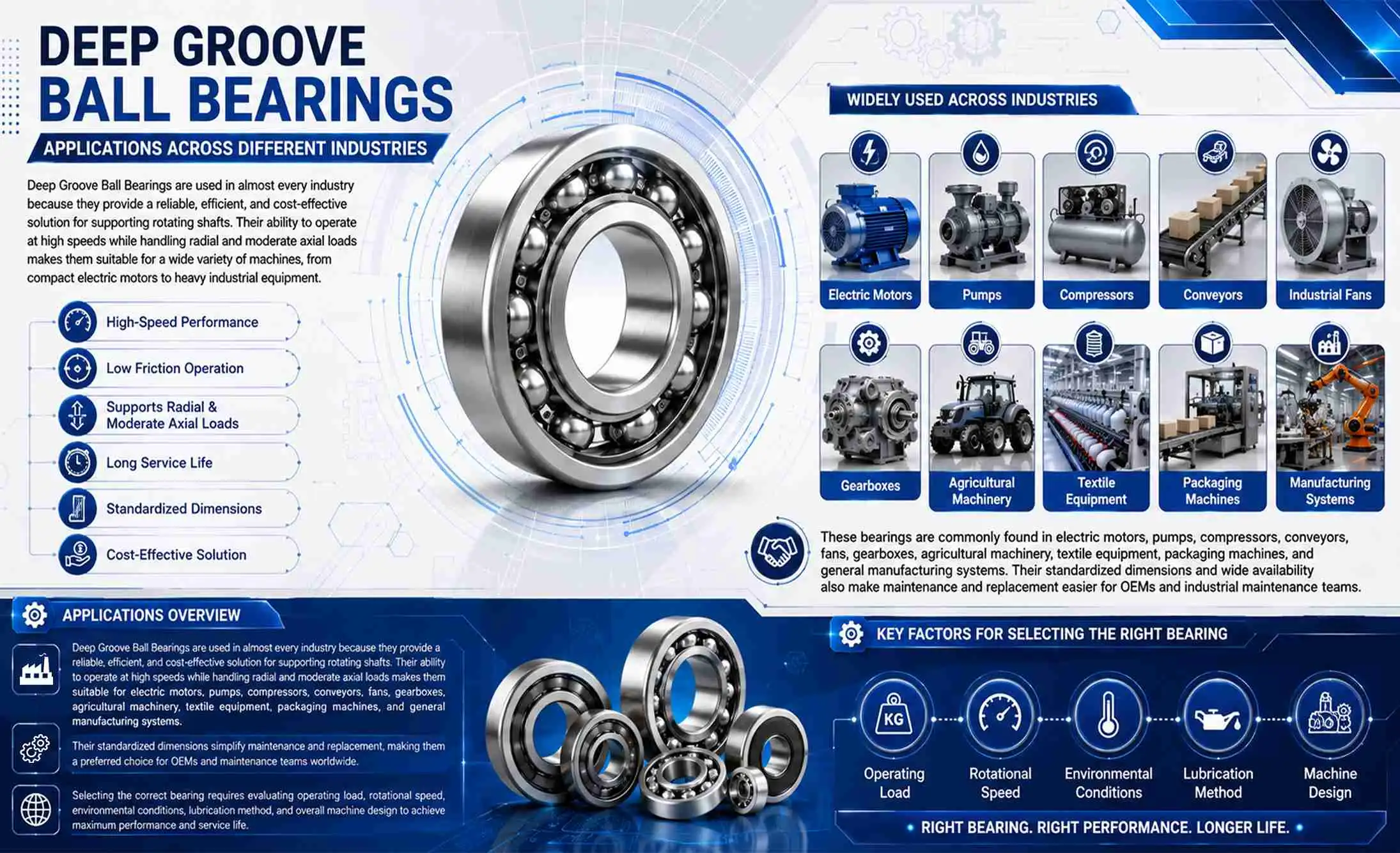
Although the operating environment differs from one industry to another, the selection process remains the same. Engineers evaluate machine speed, load, contamination levels, temperature, and maintenance requirements before choosing the most suitable bearing.
Manufacturing, Mining and Cement Plants
Manufacturing facilities rely on Deep Groove Ball Bearings in production equipment, machine tools, conveyors, and automated systems that operate continuously throughout the day. Their low-friction design helps improve machine efficiency while reducing wear on rotating components.
In mining and cement plants, bearings are commonly used in auxiliary equipment such as conveyor systems, electric motors, pumps, cooling fans, and material handling machinery. Since these environments often contain dust and abrasive particles, selecting the appropriate sealing arrangement and lubrication method is essential for maintaining reliable performance.
For industrial applications requiring different bearing sizes, explore our 6000 Series, 6200 Series, and 6300 Series Deep Groove Ball Bearings to compare available options.
Agriculture, Textile and Food Processing
Agricultural machinery operates in environments exposed to dust, moisture, vibration, and varying loads. Deep Groove Ball Bearings are widely used in tractors, seed processing equipment, irrigation pumps, harvesting machinery, and other rotating equipment where dependable operation is important during seasonal production.
In textile and food processing industries, bearings are commonly installed in motors, rollers, conveyors, packaging machines, and processing equipment. Their smooth operation and availability in sealed designs help reduce maintenance requirements while supporting continuous production.
Choosing the correct bearing configuration for the operating environment helps improve equipment reliability and minimize production interruptions.
Automotive, Packaging and General Engineering
Deep Groove Ball Bearings are extensively used in automotive manufacturing, packaging equipment, and general engineering applications because of their compact design and high-speed capability. They are commonly found in electric motors, belt-driven systems, small gear units, conveyors, and automated production machinery.
For OEM manufacturers and maintenance teams, standardized bearing dimensions simplify equipment servicing and replacement while reducing inventory requirements. This makes Deep Groove Ball Bearings a practical solution for industries that depend on reliable, uninterrupted machine operation.
If you're selecting a bearing for a new machine or replacement application, understanding the operating conditions is just as important as knowing where the bearing will be used. The next section explains how to choose the right Deep Groove Ball Bearing based on machine requirements, operating speed, and load conditions.
Selecting the Right Deep Groove Ball Bearing for Your Application
Choosing the right Deep Groove Ball Bearing is essential for achieving reliable machine performance and maximizing bearing life. While these bearings are available in standardized sizes and series, the best choice depends on the machine's operating conditions rather than simply matching the dimensions.
Engineers and maintenance teams typically evaluate factors such as load, operating speed, shaft size, environmental conditions, and lubrication requirements before selecting a bearing. Considering these parameters early helps reduce maintenance costs and improves long-term equipment reliability.
Matching Bearing Size to the Machine
Every machine is designed around specific shaft and housing dimensions, making it important to select a bearing that matches the required bore diameter, outside diameter, and width. Standardized bearing series simplify this process while ensuring compatibility across different industrial applications.
The 6000 Series is commonly used for compact equipment, the 6200 Series suits a wide range of general industrial machinery, and the 6300 Series is preferred for applications requiring greater radial load capacity. Selecting the correct series helps achieve the right balance between available space and machine performance.
If you're comparing different bearing sizes, explore our 6000 Series, 6200 Series, and 6300 Series Deep Groove Ball Bearings pages to understand their typical applications and available specifications.
Operating Speed, Load and Working Environment
A bearing should always be selected according to the operating conditions of the equipment. High-speed machines require bearings capable of minimizing friction and heat generation, while heavier applications demand bearings with adequate load-carrying capacity and durability.
The working environment is equally important. Factors such as dust, moisture, vibration, high temperatures, and chemical exposure can influence bearing performance and determine whether an open, shielded, or sealed bearing is the most appropriate choice.
Understanding these operating conditions before purchasing helps improve bearing reliability and reduces the risk of premature failure.
Lubrication and Maintenance Requirements
Even the correct bearing will not achieve its expected service life without proper lubrication and routine maintenance. Lubrication reduces friction between the rolling elements and raceways, helps dissipate heat, and protects internal components from wear and corrosion.
Regular inspections also help identify early signs of vibration, noise, overheating, or lubricant contamination before they develop into costly equipment failures. Following a preventive maintenance schedule improves bearing performance and minimizes unexpected production downtime.
For a broader understanding of bearing selection, installation, and maintenance best practices, continue reading our Deep Groove Ball Bearings: The Complete Industrial Guide to Types, Applications & Selection, where these topics are explained in greater detail.
Common Application Challenges and Best Practices
Deep Groove Ball Bearings are designed to provide reliable performance across a wide range of industrial applications. However, their service life depends not only on bearing quality but also on how well they are selected, installed, lubricated, and maintained throughout operation.
Many bearing-related problems develop gradually and can be prevented through proper application practices. Understanding the most common challenges helps maintenance teams improve equipment reliability, reduce downtime, and maximize bearing performance.
Preventing Premature Bearing Failure
Premature bearing failure is often caused by incorrect bearing selection, inadequate lubrication, contamination, improper mounting, or operating the bearing beyond its recommended load and speed limits. These issues can lead to increased vibration, excessive heat generation, abnormal noise, and early component wear.
Selecting a bearing that matches the application's operating conditions and following the manufacturer's installation and maintenance recommendations can significantly improve bearing life. Regular inspections also help identify potential issues before they result in costly machine failures.
Improving Bearing Service Life
Extending bearing service life begins with selecting the correct bearing series and ensuring proper installation. Maintaining clean operating conditions, using the appropriate lubricant, and following recommended maintenance intervals all contribute to consistent bearing performance.
Monitoring operating temperature, vibration, and lubrication condition allows maintenance teams to detect wear at an early stage. A proactive maintenance strategy reduces unexpected downtime, improves equipment reliability, and lowers the total cost of ownership over the bearing's operating life.
Choosing a Reliable Bearing Supplier
The performance of a Deep Groove Ball Bearing depends not only on proper application but also on the quality and consistency of the bearing itself. Working with a trusted supplier ensures access to bearings manufactured to recognized quality standards, supported by accurate technical information and dependable product availability.
Whether you're sourcing bearings for OEM production, industrial maintenance, or replacement applications, selecting the right supplier helps ensure long-term machine reliability. Explore our Single Row Deep Groove Ball Bearings range to compare available products, or return to our Deep Groove Ball Bearings: The Complete Industrial Guide to Types, Applications & Selection for a broader understanding of bearing types, applications, and selection criteria.