What Are Deep Groove Ball Bearings? Types, Construction & Working Principle
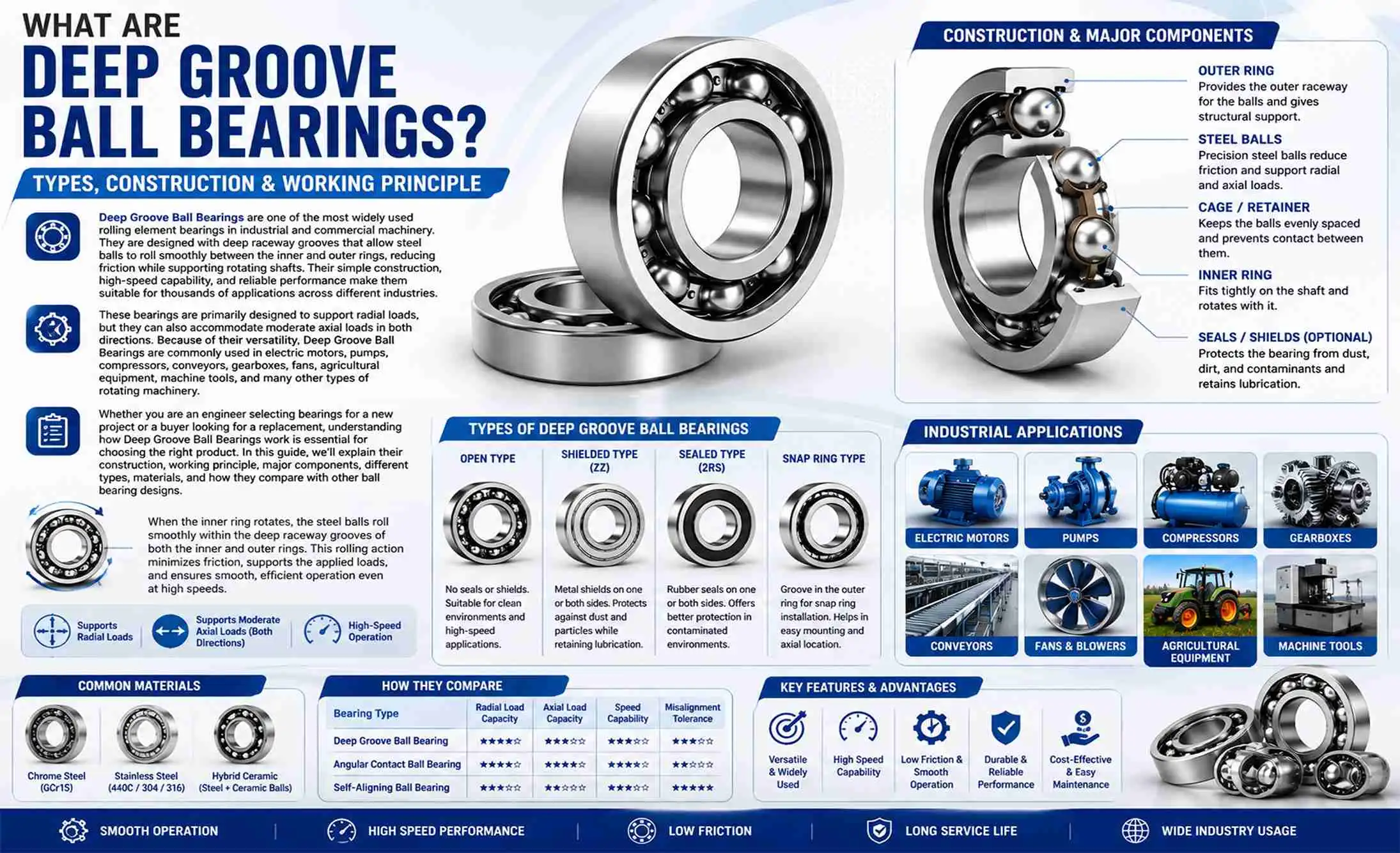
Deep Groove Ball Bearings are one of the most widely used rolling element bearings in industrial and commercial machinery. They are designed with deep raceway grooves that allow steel balls to roll smoothly between the inner and outer rings, reducing friction while supporting rotating shafts. Their simple construction, high-speed capability, and reliable performance make them suitable for thousands of applications across different industries.
These bearings are primarily designed to support radial loads, but they can also accommodate moderate axial loads in both directions. Because of their versatility, Deep Groove Ball Bearings are commonly used in electric motors, pumps, compressors, conveyors, gearboxes, fans, agricultural equipment, machine tools, and many other types of rotating machinery.
Whether you are an engineer selecting bearings for a new project or a buyer looking for a replacement, understanding how Deep Groove Ball Bearings work is essential for choosing the right product. In this guide, we'll explain their construction, working principle, major components, different types, materials, and how they compare with other ball bearing designs.
What Are Deep Groove Ball Bearings?
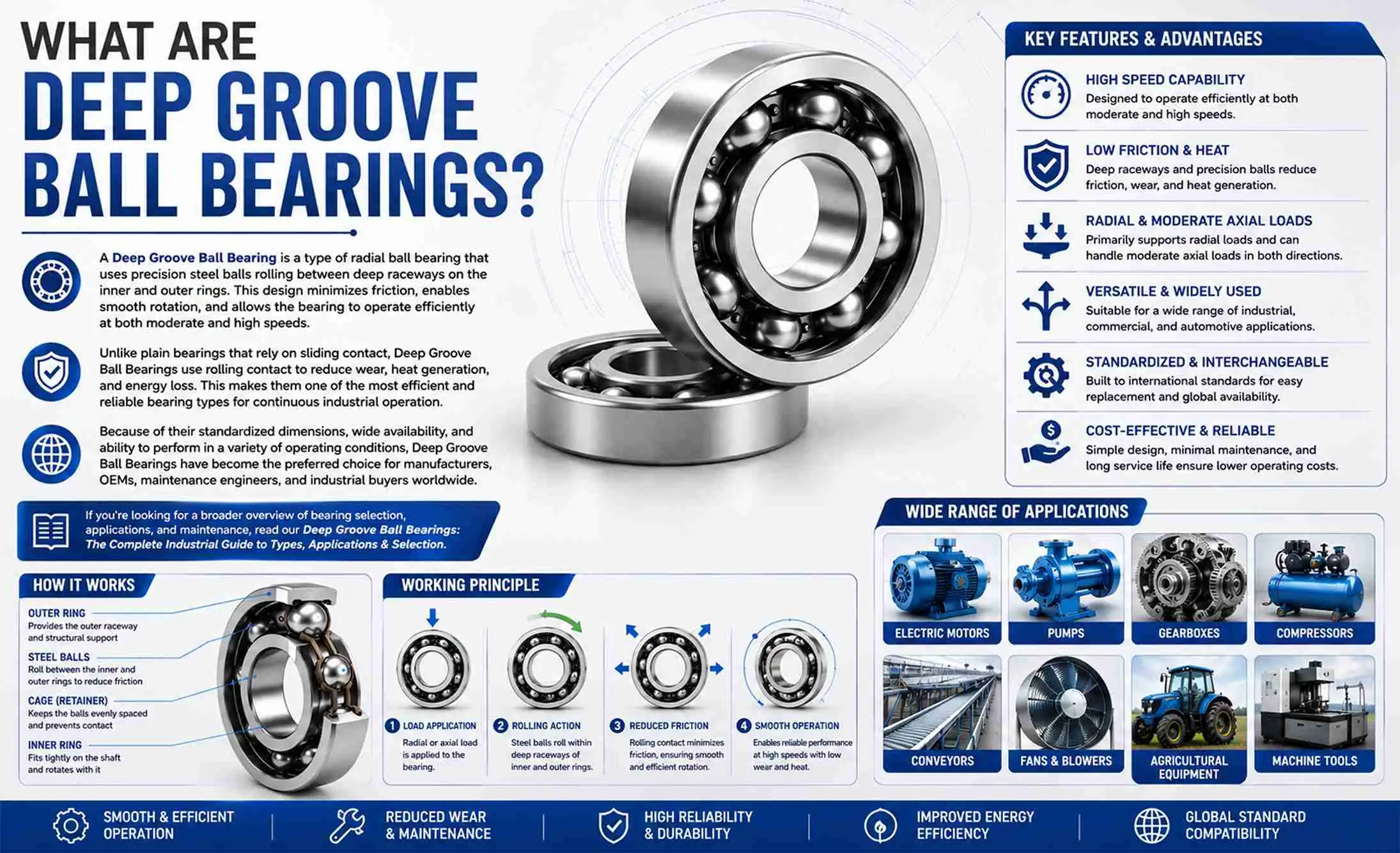
A Deep Groove Ball Bearing is a type of radial ball bearing that uses precision steel balls rolling between deep raceways on the inner and outer rings. This design minimizes friction, enables smooth rotation, and allows the bearing to operate efficiently at both moderate and high speeds.
Unlike plain bearings that rely on sliding contact, Deep Groove Ball Bearings use rolling contact to reduce wear, heat generation, and energy loss. This makes them one of the most efficient and reliable bearing types for continuous industrial operation.
Because of their standardized dimensions, wide availability, and ability to perform in a variety of operating conditions, Deep Groove Ball Bearings have become the preferred choice for manufacturers, OEMs, maintenance engineers, and industrial buyers worldwide. If you're looking for a broader overview of bearing selection, applications, and maintenance, read our Deep Groove Ball Bearings: The Complete Industrial Guide to Types, Applications & Selection.
Definition and Basic Design
The term "Deep Groove" refers to the specially designed raceway grooves on both the inner and outer rings. These grooves closely match the size of the rolling balls, allowing the bearing to support loads efficiently while maintaining smooth and accurate rotation.
A standard Deep Groove Ball Bearing consists of an inner ring, outer ring, steel balls, and a cage (retainer) that keeps the rolling elements evenly spaced. Depending on the application, bearings may also include metal shields or rubber seals to retain lubricant and prevent contaminants from entering the bearing.
This simple yet highly effective design allows Deep Groove Ball Bearings to deliver excellent performance with minimal maintenance, making them suitable for everything from compact electric motors to heavy industrial machinery.
Why They Are the Most Widely Used Ball Bearings
Deep Groove Ball Bearings are the most commonly used ball bearings because they combine high-speed performance, low friction, long service life, and versatile load-carrying capability. They are also available in a wide range of sizes, bore diameters, and sealing options to meet different industrial requirements.
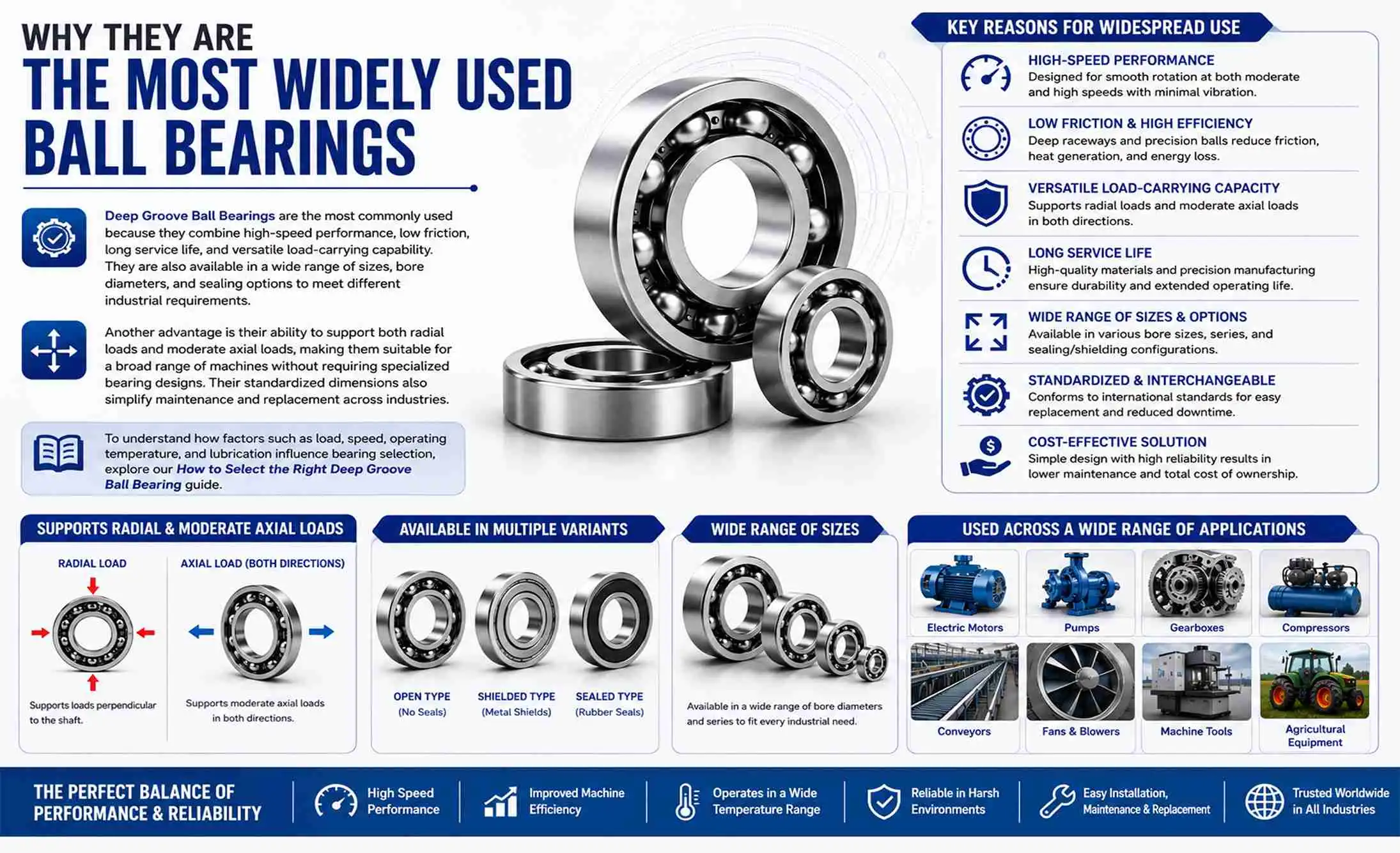
Another advantage is their ability to support both radial loads and moderate axial loads, making them suitable for a broad range of machines without requiring specialized bearing designs. Their standardized dimensions also simplify maintenance and replacement across industries.
To understand how factors such as load, speed, operating temperature, and lubrication influence bearing selection, explore our How to Select the Right Deep Groove Ball Bearing guide.
Where Deep Groove Ball Bearings Are Commonly Used
Deep Groove Ball Bearings are used in industries where reliable rotational movement and high operating efficiency are essential. Their versatility allows them to perform in both light-duty and heavy-duty equipment operating under continuous conditions.
They are commonly found in electric motors, industrial pumps, gearboxes, fans, conveyors, compressors, agricultural machinery, textile equipment, HVAC systems, machine tools, and general manufacturing equipment. Different bearing series are selected based on machine size, operating load, and speed requirements.
If you're exploring bearings for a specific machine or industry, our Deep Groove Ball Bearings Applications Across Different Industries guide explains where these bearings are used and how to select the right solution. For product specifications and available sizes, you can also explore our Single Row Deep Groove Ball Bearings range.
Construction and Main Components of Deep Groove Ball Bearings
Although Deep Groove Ball Bearings have a simple design, each component is engineered to work together with high precision. The quality of these components directly affects bearing performance, operating speed, load capacity, and service life.
Understanding the construction of a Deep Groove Ball Bearing helps engineers and maintenance teams identify the right bearing for their application while also making it easier to diagnose wear and prevent premature failure.
Inner Ring, Outer Ring and Raceway
The inner ring is mounted on the rotating shaft, while the outer ring fits securely inside the bearing housing. Both rings contain precision-machined raceways, which guide the rolling balls and distribute loads evenly during operation.
The deep raceway grooves are what distinguish Deep Groove Ball Bearings from other ball bearing designs. They provide greater contact with the rolling balls, allowing the bearing to support radial loads efficiently while also accommodating moderate axial loads in both directions.
The accuracy of these raceways plays a major role in reducing vibration, minimizing friction, and ensuring smooth rotation. This is why high-quality bearings are manufactured with strict dimensional tolerances and precision grinding.
Rolling Balls and Cage (Retainer)
The rolling balls are the primary load-carrying elements of the bearing. As the shaft rotates, they roll smoothly between the inner and outer raceways, significantly reducing friction compared to sliding contact.
Keeping these balls evenly spaced is the job of the cage, also known as the retainer. The cage prevents the balls from rubbing against each other, maintains uniform spacing, and helps ensure smooth, quiet operation at high rotational speeds.
Depending on the application, cages may be manufactured from pressed steel, machined brass, or engineering polymers, with the material selected based on operating speed, load, temperature, and lubrication conditions.
Seals, Shields and Lubrication System
Deep Groove Ball Bearings are available as open, shielded, and sealed designs to suit different operating environments. The choice depends on the level of contamination, maintenance schedule, and lubrication requirements.
Open bearings allow external lubrication and are suitable for clean environments where regular maintenance is possible. Shielded bearings use metal shields to reduce dust ingress, while sealed bearings use rubber seals to retain grease and provide better protection against moisture, dirt, and other contaminants.
Proper lubrication is equally important because it reduces friction, limits wear, protects against corrosion, and helps dissipate heat generated during operation. If you'd like to understand the differences between these designs, read our Open vs Shielded vs Sealed Deep Groove Ball Bearings guide. You can also explore our Deep Groove Ball Bearing Lubrication Guide to learn how proper lubrication improves bearing performance and extends service life.
Working Principle of Deep Groove Ball Bearings
The working principle of a Deep Groove Ball Bearing is based on rolling contact, which allows machine components to rotate with significantly less friction than sliding surfaces. As the shaft rotates, the balls roll smoothly between the inner and outer raceways, helping the bearing support loads while minimizing wear and heat generation.
This efficient design enables Deep Groove Ball Bearings to operate at high speeds with consistent performance. Their ability to handle both radial and moderate axial loads makes them suitable for a wide variety of industrial machines and rotating equipment.
How Rolling Contact Reduces Friction
Unlike plain bearings that rely on sliding movement, Deep Groove Ball Bearings use hardened steel balls that roll between precision-ground raceways. Rolling contact creates much less resistance, allowing machinery to run more efficiently while consuming less energy.
Lower friction also means reduced heat generation and slower wear of bearing components. This contributes to smoother operation, improved reliability, and longer service life, especially in applications that run continuously.
Proper lubrication further enhances rolling performance by creating a thin protective film between the rolling elements and raceways. Learn more about lubrication methods in our Deep Groove Ball Bearing Lubrication Guide.
How Radial and Axial Loads Are Supported
Deep Groove Ball Bearings are primarily designed to support radial loads, which act perpendicular to the shaft. The deep raceway grooves provide stable contact with the rolling balls, allowing loads to be distributed evenly across the bearing.
In addition to radial loads, these bearings can also support moderate axial loads from both directions. This dual load-carrying capability makes them suitable for equipment where both types of forces are present, such as electric motors, pumps, fans, and gearboxes.
Selecting the right bearing depends on factors such as load direction, operating speed, and application requirements. Our How to Select the Right Deep Groove Ball Bearing guide explains these considerations in greater detail.
Why Deep Groove Ball Bearings Operate at High Speeds
Deep Groove Ball Bearings are known for their excellent high-speed performance because of their optimized internal design and low-friction rolling contact. Precision-manufactured raceways, balanced rolling elements, and proper lubrication help minimize vibration and heat even at higher rotational speeds.
Their compact design and accurate manufacturing also contribute to smooth and quiet operation, making them suitable for equipment where efficiency and reliability are important. However, achieving maximum bearing life still depends on correct installation, proper lubrication, and selecting a bearing that matches the operating conditions.
If you're comparing different bearing sizes for high-speed or heavy-duty applications, explore our 6000 Series, 6200 Series, and 6300 Series Deep Groove Ball Bearings. You can also refer to our Deep Groove Ball Bearing Size Chart to understand how different series are selected for various industrial applications.
Types and Materials of Deep Groove Ball Bearings
Deep Groove Ball Bearings are available in different configurations and materials to meet the requirements of various industrial applications. The right combination depends on operating speed, load, environmental conditions, lubrication requirements, and maintenance practices.
Understanding the available bearing types and material options helps engineers and buyers select products that deliver reliable performance, longer service life, and lower maintenance costs.
Single Row, Open, Shielded and Sealed Bearings
Single Row Deep Groove Ball Bearings are the most widely used configuration because they offer a compact design, high-speed capability, and reliable performance under radial and moderate axial loads. They are commonly used in electric motors, pumps, fans, gearboxes, conveyors, and other rotating machinery.
Depending on the operating environment, these bearings are available as open, shielded, or sealed designs. Open bearings are suitable for applications with external lubrication, while shielded and sealed bearings provide additional protection against dust, moisture, and contaminants, helping retain lubricant for longer service life.
To explore product specifications and available sizes, visit our Single Row Deep Groove Ball Bearings page. If you're unsure which configuration is best for your application, read our Open vs Shielded vs Sealed Deep Groove Ball Bearings guide for a detailed comparison.
Chrome Steel, Stainless Steel and Ceramic Bearings
The material used in a Deep Groove Ball Bearing has a direct impact on its performance, durability, and suitability for different operating conditions. Most industrial bearings are manufactured from high-carbon chromium steel, commonly known as chrome steel, because it offers excellent hardness, fatigue resistance, and wear resistance after heat treatment.
For applications exposed to moisture or corrosive environments, stainless steel bearings provide improved corrosion resistance. In specialized high-speed or electrically insulated applications, ceramic or hybrid ceramic bearings are also used due to their lower weight, reduced friction, and excellent resistance to heat and corrosion.
The right material depends on the application's operating environment, load, speed, and maintenance requirements. Selecting the appropriate material helps maximize bearing life while improving equipment reliability.
Bearing Series (6000, 6200 & 6300)
Deep Groove Ball Bearings are manufactured in standardized series, with the 6000, 6200, and 6300 Series being among the most commonly used in industrial applications. Each series has different bore sizes, outside diameters, widths, and load capacities while following internationally standardized dimensions.
The 6000 Series is generally preferred for compact equipment and lighter loads, the 6200 Series offers a balance between size and load capacity for general industrial use, and the 6300 Series is designed for applications requiring higher radial load capacity and greater durability.
You can explore our dedicated pages for 6000 Series Deep Groove Ball Bearings, 6200 Series Deep Groove Ball Bearings, and 6300 Series Deep Groove Ball Bearings to compare available sizes and specifications. For a detailed technical comparison, read our guide on 6000 vs 6200 vs 6300 Series Bearings, which explains when each series is the most suitable choice for industrial machinery.
Deep Groove Ball Bearings vs Standard Ball Bearings
The term ball bearing refers to a broad category of rolling bearings that use balls as the rolling elements to reduce friction between moving parts. Deep Groove Ball Bearings are one of the most common types within this category, but they are not the only design available.
Each ball bearing type is engineered to solve a different engineering challenge. Understanding these differences helps engineers, maintenance professionals, and procurement teams select a bearing that matches the machine's operating conditions rather than simply choosing a bearing based on size.
What Makes Deep Groove Ball Bearings Different?
The defining feature of a Deep Groove Ball Bearing is its deep raceway grooves, which allow the rolling balls to maintain greater contact with the inner and outer rings. This design enables the bearing to carry radial loads efficiently while also supporting moderate axial loads from both directions.
Their simple construction, standardized dimensions, and ability to operate at high rotational speeds make them suitable for a wide range of industrial applications. This combination of versatility and reliability is why Deep Groove Ball Bearings are often the first choice for general-purpose rotating equipment.
Comparing Their Performance in Industrial Applications
Compared to many other ball bearing designs, Deep Groove Ball Bearings provide an excellent balance of speed, efficiency, durability, and maintenance simplicity. They perform exceptionally well in applications where low friction, smooth rotation, and long service life are essential.
This is why they are widely used in electric motors, pumps, compressors, fans, conveyors, machine tools, and agricultural equipment. Their standardized sizes also simplify replacement, helping maintenance teams reduce inventory complexity and equipment downtime.
To see how these bearings are used across different industries and machines, explore our Deep Groove Ball Bearings Applications Across Different Industries guide.
How to Decide If a Deep Groove Ball Bearing Is Right for Your Equipment
Before selecting any bearing, consider the operating conditions of your machine rather than focusing only on the bearing number. Factors such as load direction, operating speed, shaft size, lubrication method, temperature, and environmental conditions all influence bearing performance and service life.
For many industrial applications, Deep Groove Ball Bearings provide the ideal combination of reliability, efficiency, and cost-effectiveness. However, comparing bearing specifications and understanding your application's requirements will help ensure you select the most suitable solution.
If you're ready to choose a bearing, continue with our Deep Groove Ball Bearings: The Complete Industrial Guide to Types, Applications & Selection for a complete overview, or explore our Single Row Deep Groove Ball Bearings, 6000 Series, 6200 Series, and 6300 Series product pages to compare available options and specifications.